

Staircase Sanding Cost Brighton: The 2026 Homeowner’s Guide
You've finally pulled back that threadbare carpet to reveal the original timber beneath, but the initial excitement is often met with a wave of uncertainty. Between the fear of pervasive dust drifting into every room and the confusion over varying quotes, it's difficult to know where to start. We believe that your hallway should be a stunning entrance, not a source of stress, which is why understanding the staircase sanding cost Brighton is the first step toward a successful restoration.
We promise to demystify the pricing process by explaining exactly what goes into a professional finish, from safety testing for lead paint to the meticulous hand-sanding of every spindle. You'll discover how modern vacuum systems capture up to 99% of dust to keep your home clean whilst we work to create a durable, beautiful focal point for your property. This guide provides a clear preview of the restoration journey, ensuring you have the peace of mind that comes from a safe pair of hands.
Key Takeaways
Understand why staircase restoration is a specialist craft that requires more intricate hand-finishing than standard pine floorboards.
Learn how to accurately estimate the staircase sanding cost Brighton homeowners can expect, based on the number of treads and the condition of the risers.
Discover our professional step-by-step approach to preparation, ensuring old staples and nails are safely removed before the sanding begins.
Find out how modern dust-extraction technology captures up to 99% of particles to protect your hallway from pervasive mess whilst we work.
Gain the confidence to restore your period property's staircase into a durable, beautiful focal point that adds long-term value to your home.
Table of Contents
Understanding Staircase Sanding in Brighton Homes
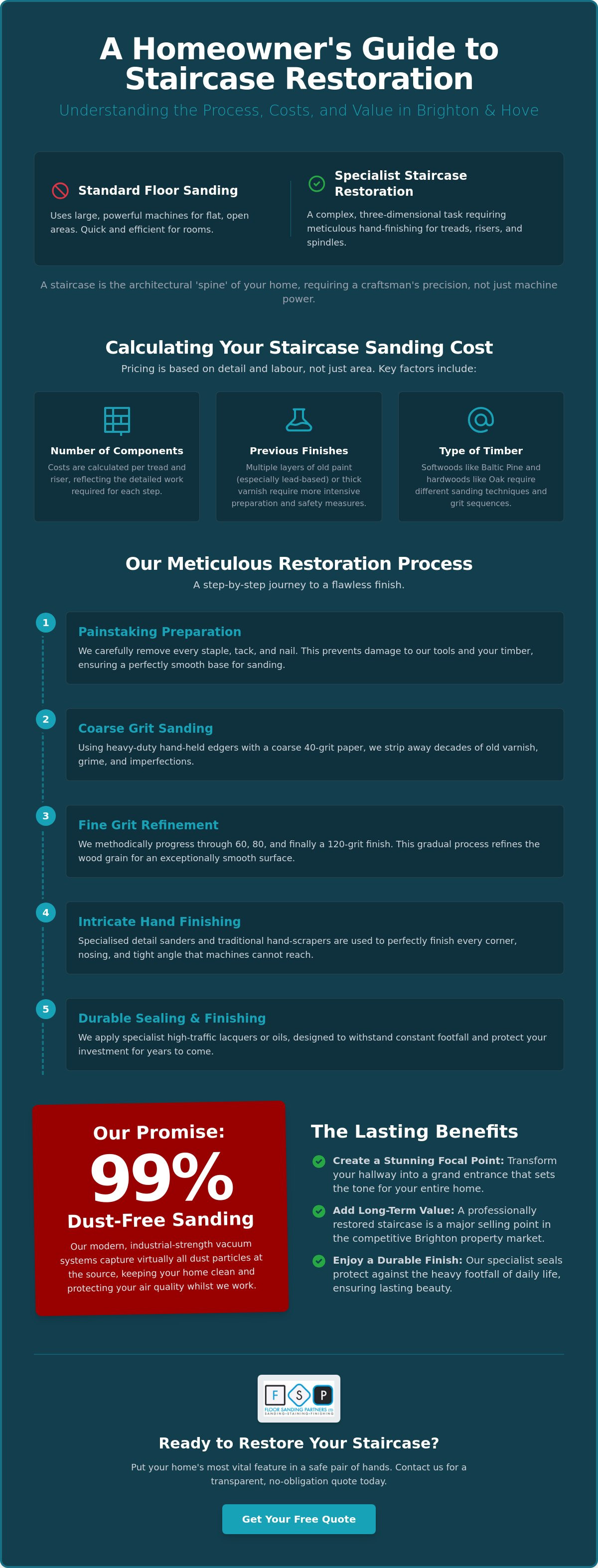
Restoring a staircase is often the most demanding part of a Brighton home renovation, yet it offers the highest emotional and aesthetic return. Whilst a flat room allows us to use large, powerful drum sanders to cover ground quickly, a staircase is a complex three-dimensional puzzle. Every step consists of a tread, a riser, and often intricate nosing, all meeting at sharp angles that large machinery simply cannot reach. This level of detail is why the staircase sanding cost Brighton homeowners encounter is structured differently from standard room rates; it reflects the transition from machine-led power to meticulous hand-finishing.
In our local area, we typically encounter two distinct types of timber. The iconic Victorian terraces of Brighton and Hove are almost exclusively fitted with Baltic pine, a wood that is beautiful but soft and prone to deep-seated grime after decades under carpet. In contrast, the more substantial Edwardian and 1920s properties in areas like Preston Park or West Hove often feature solid oak components. Each species requires a tailored approach during the wood finishing process to ensure the grain is highlighted rather than obscured. Because pine is more porous, it demands a different sanding grit sequence than the dense, stubborn fibres of oak.
The variation in pricing across Sussex often stems from the condition of these specific timbers. A staircase that has been painted with multiple layers of lead-based gloss requires significantly more preparation and safety equipment than one that was simply varnished. We focus on transparency, ensuring you understand that the staircase sanding cost Brighton specialists provide covers not just the visible surface, but the structural integrity and safety of the wood itself.
The Architectural Focal Point
Your staircase is the first thing guests see when they enter your hallway. In the competitive Brighton and Hove property market, a professionally restored staircase acts as a powerful architectural statement that can tangibly increase a home's appeal. It's the "spine" of the property, connecting your living spaces and setting the tone for the entire interior design. We often find that clients see the best results when they coordinate this work with professional floor sanding in Brighton and Hove for their entrance halls, creating a seamless flow of natural timber throughout the ground floor.
Hallways and stairs are the highest-traffic zones in any home. Because these areas endure constant footfall, they require specialist hard-wearing finishes that standard furniture oils can't provide. We use high-traffic lacquers and oils designed to withstand the vertical and horizontal pressures unique to stairs, ensuring your investment remains a beautiful, durable focal point for years to come. Our team treats every spindle and stringer with the precision of a seasoned craftsman, providing you with a safe pair of hands for your home's most vital feature.
How to Sand Wooden Stairs: A Professional Step-by-Step Guide
The journey from a carpet-covered relic to a polished masterpiece begins with painstaking preparation. We start by removing every last staple and tack that once held the carpet in place. It's a slow process. If a single metal fragment is missed, it can tear through our sanding belts or, worse, leave deep gouges in the timber that are difficult to repair. We also check for protruding nails, setting them below the surface to ensure a level finish. This meticulous groundwork is a significant factor in the staircase sanding cost Brighton homeowners pay, as it ensures the wood is safe and ready for the machines.
Once the timber is clear, we begin the initial sand. Unlike a bedroom floor where we'd use a large drum sander, stairs require heavy-duty hand-held edgers. We typically start with a coarse 40-grit paper to strip away decades of grime and old varnish. From there, we follow a strict grit progression, moving to 60, 80, and finally a smooth 120-grit finish. This methodical approach ensures that the grain is opened up and then gradually refined, creating a surface that is perfectly prepared to accept a new seal.
Essential Tools for Stair Restoration
You can't sand a staircase with standard floor machinery; the space is simply too tight. We rely on specialised detail sanders, often referred to as "Fein" tools, to reach into the corners and under the "nosing" of each tread. For the tightest angles where even a detail sander can't reach, we use traditional hand-scrapers. Safety is our priority during this stage. We use industrial-strength dust extraction because we're acutely aware of the health hazards of wood dust, which can be particularly concentrated in narrow hallways.
Dealing with Old Paint and Varnish
Older Brighton properties often hide layers of lead-based paint. If we suspect lead, we avoid dry sanding and instead use chemical strippers or controlled heat to safely remove the bulk of the material. This "strip and sand" method is more labour-intensive than a standard sand, but it's essential for a high-quality result. If you're feeling overwhelmed by the complexity of these steps, you might find it easier to trust a specialist in staircase sanding to handle the heavy lifting and the mess for you.
Finally, we apply the protection. Because your stairs are a high-traffic zone, we recommend three coats of high-quality, slip-resistant varnish or a hard-wax oil. This final layer doesn't just look beautiful; it provides the durability your home needs. Understanding this labour-intensive process helps clarify why the staircase sanding cost Brighton specialists quote is based on precision and time rather than just square footage.
Calculating the Staircase Sanding Cost in Brighton
When you start looking for a quote, you'll notice that the staircase sanding cost Brighton professionals provide is rarely calculated by the square metre. Unlike a flat bedroom floor, where a machine can cover vast areas in minutes, a staircase is measured in units. Most specialists quote per "tread"-the horizontal surface you step on-and per "riser"-the vertical face between steps. This unit-based pricing reflects the reality that each step requires the same amount of meticulous hand-tool work, regardless of its size. It's a precise way to ensure the quote matches the physical labour involved.
The distinction between treads and risers is vital for your budget. Some homeowners choose to sand and seal only the treads whilst painting the risers a crisp white to create a modern aesthetic. This can reduce the total cost, as sanding a vertical riser is physically demanding and time-consuming. However, if you're looking for a full timber look, both surfaces must be stripped and finished to the same high standard. If your stairs are currently buried under layers of old gloss paint, expect a surcharge. Stripping paint is a chemical and manual process that can double the time required compared to a simple varnish refresh.
Intricate woodwork like spindles and balustrades also plays a significant role in your final investment. If these features require hand-sanding to match the new finish of the treads, the labour involved increases exponentially. It is often these fine details that separate a basic job from a truly professional restoration. We find that focusing on these elements transforms a functional staircase into a genuine piece of furniture.
Labour vs. Material Costs
In our experience, labour typically accounts for around 80% of your final quote. This isn't because materials are cheap, but because the manual effort required is so intensive. We don't cut corners on the remaining 20%. We use premium, high-traffic finishes from brands like Bona or Junckers to ensure your stairs remain beautiful for years. Additionally, if your old pine boards have developed gaps, we recommend gap filling using wood slithers. This technique uses actual strips of reclaimed wood rather than resin, providing a more stable result that doesn't crack under the pressure of daily use.
Additional Restoration Factors
Before we even pick up a sander, we address structural issues. Creaky steps or loose nosing aren't just annoying; they can be safety hazards. Repairing these elements ensures the wood doesn't shift during the sanding process, which could ruin the finish. The width and accessibility of your staircase also matter. Narrow, winding "kite" steps in older Brighton cottages require more precision than a wide, straight flight in a Victorian villa. As a family-run business, we pride ourselves on providing transparent, fixed quotes. We believe you should know exactly what your staircase sanding cost Brighton entails from the start, with no hidden surprises halfway through the work.
Managing the Mess: Dustless Sanding and Hallway Logistics
The hallway is the heart of your home. It is also the most sensitive area for dust migration because it acts like a chimney, funnelling fine particles from the staircase into every upstairs bedroom and downstairs living space. This "chimney effect" is a primary concern for many homeowners, and it is a factor that often influences the staircase sanding cost Brighton residents find in various quotes. Cheaper, traditional sanding methods often result in a fine film of wood dust settling on your favourite books and furniture for weeks after the job is finished. We believe your home deserves better than a lingering mess.
We take a proactive approach to protecting your living environment. Before we even turn on a machine, we meticulously seal off adjacent rooms with protective sheeting. This creates a physical barrier that keeps the work zone contained. However, the real secret to a clean home lies in the machinery itself. By using advanced extraction systems, we manage the mess at the source. This prevents the pervasive dust clouds associated with old-fashioned sanding and ensures the staircase sanding cost Brighton you invest in includes a premium level of care for your property.
The Dust-Free Promise
Modern dustless sanding is a standard we strictly adhere to. We use industrial-grade HEPA extraction units that connect directly to our specialised hand-held sanders. These vacuums are designed to capture up to 99% of wood particles. Dustless sanding is a system that captures particles at the point of contact before they become airborne. This technology protects your home's air quality and ensures that your decor remains pristine whilst we restore your timber to its former glory.
Living with the Project
We know that losing access to your stairs is a major disruption to your daily routine. Typically, a standard staircase restoration takes between one and three days, depending on the number of steps and the complexity of the finish. We organise our work programme to keep you informed at every stage, ensuring you know exactly when you can transition between floors. We usually recommend that homeowners avoid using the stairs for at least four to six hours after each coat of lacquer is applied. Full curing usually takes around 24 hours, so we often schedule the final coat for the late afternoon to allow the timber to harden undisturbed overnight.
Our team is dedicated to making the process as smooth as possible, providing a safe pair of hands for your project. If you are worried about the logistics of a renovation in your hallway, our team is here to guide you through a dust-free staircase sanding experience that respects your home and your time.
Choosing Expert Staircase Restoration in Sussex
Brighton’s architectural heritage is unique, and period properties require a level of care that generic floor sanding companies often overlook. When you are comparing a staircase sanding cost Brighton quote, it's essential to look beyond the bottom line. A lower price might indicate a lack of specialised equipment or a "one-size-fits-all" approach that doesn't account for the delicate nature of Victorian pine. We believe that choosing a local specialist is the only way to ensure your home's historical features are preserved rather than merely sanded down.
Evaluating a quote requires asking the right questions to avoid hidden extras. You should always clarify if the price includes lead paint testing, the specific brand of high-traffic lacquer being used, and whether the company uses professional dust extraction. A transparent quote should be fixed and itemised. This clarity allows you to understand exactly how your investment is being used to create a durable, beautiful focal point in your hallway. Our goal is to provide that peace of mind from the very first conversation.
Why a Specialist Makes the Difference
The risks of a DIY attempt or hiring an inexperienced generalist are particularly high on a staircase. Narrow treads and winding "kite" steps are difficult to navigate with heavy machinery. We often see timber that has been "gouged" by the improper use of an edger, leaving deep circular scars that are nearly impossible to hide. A specialist ensures a seamless transition between your stairs and the landing floor, creating a unified look throughout the home. We also insist on using traditional wood slithers for gap filling. This method involves glued wedges of reclaimed timber rather than resin, ensuring the repairs move naturally with the wood and don't crack under footfall.
Your Local Brighton Partners
At Floor Sanding Partners Ltd, we don't just see ourselves as contractors; we are neighbours. Tony and Kamber bring over 18 years of experience to every project across Sussex, combining meticulous craftsmanship with the honest values of a family-run business. We understand that your hallway is a high-traffic area, so we work with a focus on reliability and professional standards to minimise the time your stairs are out of action. We take immense pride in our work, treating every spindle and riser with the precision it deserves.
A professionally restored staircase is an investment that pays dividends in both property value and daily enjoyment. If you're ready to move away from dusty carpets and reveal the hidden beauty of your timber, we're here to help. You can trust us to provide a safe pair of hands for your home restoration journey. Contact Floor Sanding Partners Ltd for a transparent staircase sanding quote and let's discuss how we can transform your hallway together.
Restore Your Home’s Architectural Heart
Restoring a staircase is a significant undertaking that requires more than just patience; it demands precision and the right equipment. You now understand that the staircase sanding cost Brighton specialists provide is based on a unit-by-unit approach to ensure every tread and riser is treated with care. By choosing a dust-free process, you can protect your home's air quality whilst achieving a stunning, durable finish that stands up to daily footfall.
We take immense pride in being a family-run business with over 18 years of specialist experience across Sussex. Our commitment to using dust-free sanding technology as standard has helped us earn more than 100 five-star reviews from local homeowners who value transparency and craftsmanship. We're here to guide you through every step of the restoration, providing a safe pair of hands for your property's most vital architectural feature.
Get a Professional Staircase Sanding Quote in Brighton and take the first step toward a beautiful new hallway. We look forward to helping you create a focal point you'll be proud of for years to come.
Frequently Asked Questions
How much does it typically cost to sand a flight of stairs in Brighton?
The cost for professional restoration in the local area generally ranges from £35 to £102 per step, depending on the timber's condition and the complexity of the project. Factors such as the number of layers of old paint and whether you require the risers to be finished alongside the treads will influence the total. We recommend an on-site inspection to provide a specific staircase sanding cost Brighton homeowners can use for accurate budgeting.
Can I sand my stairs myself with a rented sander?
Whilst you can rent equipment, DIY staircase sanding is notoriously difficult due to the tight angles and the risk of permanent timber damage. Standard rental sanders are often too bulky for narrow treads, which leads many homeowners to accidentally "gouge" the wood. Professional results require specialised detail sanders and hand-scrapers that provide a level of precision that is difficult to achieve without professional experience.
How long does it take to sand and varnish a standard staircase?
A standard flight of stairs usually takes between one and three days to complete from start to finish. The first day is dedicated to meticulous preparation and the initial coarse sanding, whilst subsequent days focus on fine-grit refinement and the application of protective seals. The exact timeline depends on the current state of the timber and the specific drying times required between coats of lacquer.
What is the best finish for high-traffic wooden stairs?
We recommend using a high-traffic, slip-resistant lacquer or a durable hard-wax oil for domestic staircases. Brands like Bona and Junckers produce specialist finishes designed specifically for the intense vertical and horizontal pressures found in a busy hallway. These professional products provide a hard-wearing surface that protects the wood whilst ensuring the safety of everyone moving between floors.
Will the dust from sanding my stairs get into my bedrooms?
Professional dustless sanding systems capture up to 99% of particles at the point of contact, preventing them from becoming airborne. We use industrial HEPA-filtered vacuums connected directly to our tools, which keeps your bedrooms and living spaces clean throughout the process. This technology effectively eliminates the pervasive "dust clouds" that were once a standard part of traditional sanding methods.
Can you sand stairs that have been painted for decades?
Yes, even stairs buried under decades of thick gloss paint can be restored using the "strip and sand" method. We carefully remove the paint layers using controlled heat or chemical strippers before beginning the actual sanding process. This is a common requirement in Victorian Brighton properties, though it does increase the labour time compared to refreshing a previously varnished surface.
Is it possible to fix creaking stairs during the sanding process?
We can certainly address structural issues like creaks and loose nosing during the essential preparation phase. By securing loose boards and using traditional wood slithers to fill gaps, we can often significantly reduce or eliminate annoying noises. Fixing these structural issues before we begin sanding ensures a stable surface and a much quieter home environment once the project is finished.
How soon can I walk on my stairs after they have been varnished?
You can typically walk on the stairs in clean socks around 4 to 6 hours after the final coat of varnish has been applied. However, the finish remains susceptible to scuffs whilst it is still curing, so we advise waiting a full 24 hours before wearing shoes or allowing pets on the surface. Full chemical curing of the protective seal usually takes between five and seven days.


Comments