

Expert Guide to Gap Filling Pine Floorboards: Methods, Benefits, and Professional Results
A quick squeeze of acrylic filler is often the worst thing you can do for gap filling pine floorboards, as these temporary fixes almost always crack and fall through within a single season. You've likely felt that icy draught whistling up from the subfloor void or noticed spiders and dust emerging from the dark spaces between your Victorian planks. It's frustrating to see a beautiful period feature marred by wide, dark gaps that make your home feel unfinished and cold.
We understand that you want a floor that feels solid underfoot and looks seamless without losing its historic character. It's about more than just aesthetics. This guide will help you discover the most durable ways to eliminate draughts and dirt traps whilst restoring the natural beauty of your wood. We'll explore the professional methods available, specifically why traditional wood slithers are the only permanent, structural solution that moves in harmony with the timber. By the end, you'll know exactly how to achieve a professional finish that provides peace of mind for decades.
Key Takeaways
Learn why Victorian subfloor ventilation and modern central heating cause timber shrinkage, creating the wide gaps found in period homes.
Discover why reclaimed wood slithers are the only structural solution for gap filling pine floorboards that remains permanent during seasonal expansion.
Understand the technical differences between resin, mastic, and timber slivers to select the most appropriate method for your floor's condition.
See how professional gap filling eliminates icy draughts and dust whilst significantly improving your home's thermal efficiency and comfort.
Identify the preparation steps required to ensure your floor restoration achieves a seamless, high-end finish that preserves the character of the wood.
Table of Contents
Why Do Pine Floorboards Develop Gaps? Understanding Your Period Home
The Physics of Timber: Why Most Floorboard Fillers Crack and Fall Out
Evaluating Your Options: Resin vs. Mastic vs. Traditional Wood Slithers
The Craft of Slither Gap Filling: A Step-by-Step Professional Guide
Achieving a Seamless Finish: Professional Floor Restoration in Brighton
Why Do Pine Floorboards Develop Gaps? Understanding Your Period Home
Most Victorian and Edwardian properties in Brighton and Hove were built with suspended timber floors designed to breathe. In these period homes, airbricks in the external walls allow a constant flow of air beneath the house to prevent damp and rot in the joists. Whilst this ventilation is essential for the building's health, it means that the void beneath your feet is essentially the same temperature as the outdoors. The gaps you see today weren't always there; they are the result of over a century of architectural and environmental changes.
When these homes were first constructed, the pine boards were laid tight. However, the introduction of central heating in the mid-20th century fundamentally changed the internal climate of our homes. Constant, dry heat causes the timber to lose moisture and shrink. Over decades, this process creates the characteristic wide gaps we see today. Different wood flooring types react differently to these conditions, but the soft pine used in British Victorian terraces is particularly prone to this movement.
Beyond the cold, these voids act as a magnet for dust and household allergens. Every time someone walks across the floor, the "bellows effect" pushes air up from the subfloor, bringing particulates and even small insects into your living space. This is why many homeowners find that no matter how often they vacuum, dust seems to reappear instantly from between the boards.
The Aesthetic vs. Functional Argument for Filling
Professional gap filling pine floorboards isn't just about looks, though the visual transformation is undeniable. Filling those dark, cavernous spaces restores the "solid floor" aesthetic that many homeowners crave, making the room feel more intentional and cared for. It also serves a practical purpose by blocking the entry points for spiders and silverfish that naturally reside in the dark, damp subfloor. For older, thinner planks, a structural fill using wood slithers can even help reduce the "give" in the floor, making it feel more stable underfoot and preventing the edges of the boards from splintering over time.
Draught-Proofing and Energy Savings
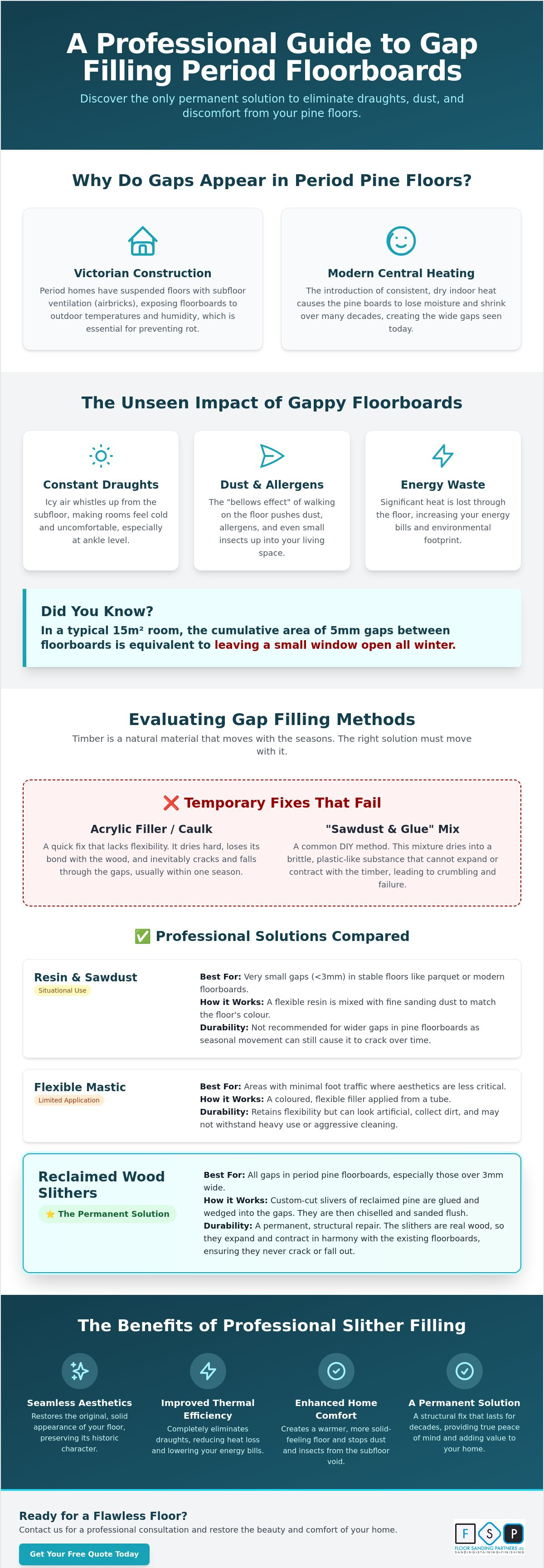
The energy impact of an unfilled floor is often underestimated. In a typical 15-square-metre room, the cumulative area of those 5mm gaps can be equivalent to leaving a small window open all winter. By addressing these gaps during a professional floor sanding Brighton and Hove project, you significantly reduce heat loss and eliminate those biting ankle-level draughts. We focus on a "breathable" restoration approach. This ensures we stop the icy air whilst maintaining the delicate moisture balance required for historic timber, preventing the floor from being sealed too tightly against the joists which could lead to moisture trapped in the subfloor void.
The Physics of Timber: Why Most Floorboard Fillers Crack and Fall Out
Wood isn't a static material. It's a biological substance that constantly absorbs and releases moisture to stay in equilibrium with the surrounding air. In Sussex homes, this translates to a relentless cycle of movement. During our humid British summers, your floorboards swell as they take in moisture from the atmosphere. When winter arrives and the central heating kicks in, the air dries out, and the timber contracts. This movement is subtle but powerful enough to destroy most off-the-shelf solutions.
Hygroscopic movement is the primary cause of filler failure because the timber never stops changing size throughout the year.
This natural rhythm is why gap filling pine floorboards often goes wrong when using the wrong materials. Many DIY enthusiasts and even some general builders rely on the "sawdust and glue" method. They mix fine sanding dust with PVA glue or a cheap resin to create a paste. It looks great for a few weeks. However, this mixture dries into a brittle, plastic-like substance that has zero flexibility. Because it cannot expand or contract with the wood, it usually cracks and crumbles within six months, leaving you back at square one with a messy floor.
The Problem with Non-Flexible Materials
Using rigid materials like wood cement, plaster, or standard decorators' caulk is a mistake for period timber. These substances are designed for static surfaces, not living wood. As the boards move, a rigid resin will eventually lose its bond and pull away from the edges. You might start hearing a distinct "crunching" sound when you walk across the room. This is the sound of failed, hardened filler being pulverised between the shifting boards. It's ineffective and can actually damage the edges of your historic pine. If you're concerned about previous failed attempts, we often recommend Sanding Pine Floorboards to clear the old debris and start fresh with a professional solution.
Moisture Levels and Acclimatisation
Success in restoration depends heavily on timing and environmental control. If we're using reclaimed pine to fill wide gaps, those boards must sit in the room for at least 14 days before we even touch a saw. This acclimatisation period ensures the new timber matches the moisture content of your existing floor. If you skip this step, the new wood will move at a different rate than the old, leading to immediate structural failure. We monitor humidity levels closely because even a small shift in the room's atmosphere can dictate whether a filler stays put for twenty years or twenty days. Precision is everything when gap filling pine floorboards in a coastal environment.
Evaluating Your Options: Resin vs. Mastic vs. Traditional Wood Slithers
Selecting the correct method for gap filling pine floorboards is a decision that dictates the longevity of your restoration. Not all gaps are created equal. A hairline fracture requires a vastly different approach than a cavernous 8mm void. We categorise these solutions based on their chemical composition and how they interact with the timber's natural movement. Whilst some methods provide a permanent structural fix, others are purely cosmetic or temporary.
Resin Filler: This is a paste created by mixing a specialist resin binder with fine dust collected during the sanding process. It is the preferred choice for narrow gaps under 2mm and is particularly effective for parquet floors where movement is minimal.
Mastic and Gap Master: These are high-quality, flexible acrylic fillers designed to remain elastic. They are best suited for perimeter gaps, expansion joints, or areas where the floor meets skirting boards.
Wood Slithers: Also known as slivers, these are tapered strips of solid wood. They are the gold standard for Victorian pine floors with gaps wider than 3mm.
Draughtex: This is a flexible, foam-like thermal strip that you press into the gaps. It is a non-permanent, non-sanded alternative that is ideal for rental properties where you cannot commit to a full professional restoration.
Why Wood Slithers are the Professional Choice
For most period homes in Sussex, we recommend Gap Filling Using Wood Slithers because it is a structural repair. We use tapered strips of reclaimed Victorian pine, ensuring the age, grain, and colour match your original boards perfectly. These slithers are glued to the side of the floorboards, not the joists. This allows the filler to move as part of the board itself. Once the glue has cured, the excess wood is planed and sanded flat. The result is a seamless, flush finish that feels as solid as a brand-new floor. It's a permanent solution that won't crack or fall through, even during the harshest winter contraction.
When to Use Resin Dust Fillers
Resin has its place, especially when dealing with "shaking" floors or very tight gaps where a wooden slither simply won't fit. By using the actual dust from your floor, the colour match is often excellent. However, resin has its limits. If used on gaps wider than 3mm, the volume of material is too great to remain stable. Over time, the weight and lack of flexibility will cause the resin to fail. We typically reserve resin for the final "fine fill" of a project, used to catch the tiny imperfections that slithers might miss. It's a secondary tool in the kit, not a primary solution for gap filling pine floorboards with significant voids.
The Craft of Slither Gap Filling: A Step-by-Step Professional Guide
Achieving professional results with gap filling pine floorboards requires more than just the right materials; it demands a meticulous, step-by-step approach that respects the age of the timber. We treat every floor as a unique restoration project. The process begins with deep preparation. We use specialist hand tools to rake out decades of accumulated debris, old bitumen, and failed fillers from every single void. Without this surgical level of cleaning, even the highest quality glue will fail to bond with the board edges.
Consistency is the next priority. We exclusively use reclaimed Victorian pine for our slithers. This timber has already spent a century drying out, meaning its cellular structure is stable and its grain pattern matches your existing floor perfectly. New pine from a local timber yard is often too soft and contains too much moisture, which leads to immediate shrinkage and failure. Once the gaps are clean and the timber is selected, we apply a specialist wood glue that remains slightly flexible after curing. We then drive the tapered slithers home with a mallet to create a tight, mechanical fit that effectively becomes part of the floor's structure.
The final stage is the transformation. After the glue has fully set, the protruding tops of the slithers are carefully planed down by hand before the entire floor undergoes a professional sanding sequence. This process levels the floor completely, erasing the visual boundaries between the original boards and the new fills. The result is a unified, flat surface that is ready for its final protective finish.
Essential Tools for the Job
Precision requires the right equipment. We utilise high-quality wood glues specifically formulated for long-term flexibility to accommodate the floor's natural movement. Our tapered wedges are cut using specialist saws that ensure a consistent V-angle for maximum contact area. Safety is also a primary concern during preparation. Many period homes in Brighton contain old bitumen residues or lead-based paint in the gaps, which we manage using industrial-grade dust extraction and appropriate filtration to keep your home environment clean and safe.
Common Mistakes to Avoid
One of the most frequent errors we see in DIY attempts is "bridging" the gap by gluing the slither to the subfloor joist. This is a critical mistake. If the slither is fixed to the joist, it cannot move when the floorboards expand, causing the boards to split or the slither to pop out. Another common pitfall is failing to remove every trace of old wax or oil from the gap edges, which prevents the glue from penetrating the wood fibres. If you want to ensure your restoration is handled with this level of technical precision, we provide expert Gap Filling Using Wood Slithers as part of our comprehensive floor restoration service.
Achieving a Seamless Finish: Professional Floor Restoration in Brighton
The meticulous process of gap filling pine floorboards is the bridge between a basic sanding job and a high-end restoration. It's the final step that ensures your Victorian floor looks like a deliberate design choice rather than an ageing relic. When we complete a professional floor sanding Brighton and Hove project, the transformation is immediate. The floor no longer looks like a series of disconnected planks; it becomes a single, unified surface that reflects light evenly across the room.
This restoration does more than just solve the problem of icy draughts and dust. It adds tangible value to your property. With the "improve, don't move" trend driving the UK home improvement market toward a projected £16.67 billion by 2033, homeowners in Sussex are increasingly investing in the longevity of their period features. A professionally filled and restored pine floor is a significant selling point. It offers the warmth of historic timber with the airtight performance and solid feel of a modern installation.
Choosing the Right Finish for Filled Floors
Your choice of finish dictates how the slithers blend with the original boards. Hardwax oils are an excellent choice for those seeking a natural, organic aesthetic. The oil penetrates both the original pine and the reclaimed slithers, highlighting the grain and creating a soft, honey-toned glow that matches the current trend for warmer wood tones. If you have a high-traffic hallway or a busy kitchen, water-based lacquers provide the best durability. These modern finishes are incredibly tough and won't yellow over time, ensuring the gap filling pine floorboards remains invisible and the surface stays easy to clean. Maintenance is straightforward; regular sweeping and the use of pH-neutral cleaners will prevent grit from wearing down the finish and exposing the timber.
Why a Specialist Approach Matters
A general builder might offer to fill your gaps, but they often lack the specialist equipment and the deep understanding of timber behaviour required for a permanent fix. We focus exclusively on floor restoration. This means we understand the unique structural challenges of Sussex period properties, from salt-air moisture levels to the specific shrinkage patterns of British pine. We don't believe in one-size-fits-all solutions or high-pressure sales. Instead, we prioritise transparency and the integrity of the craft. We act as a safe pair of hands for your home's history. If you're ready to transform your living space, contact Floor Sanding Partners to organise a local site survey in Brighton or Hove. We'll provide an honest assessment and a clear plan to restore the beauty and comfort of your floors.
Restore the Warmth and Character of Your Period Home
Restoring the integrity of your Victorian floors is about more than just aesthetics. It's about preserving the history and comfort of your living space. We've explored why reclaimed timber slithers are the only structural, permanent solution for gap filling pine floorboards. This method ensures your floor remains draught-free and solid even as the seasons change. By choosing a solution that moves in harmony with the wood, you eliminate those icy subfloor breezes and create a seamless finish that lasts for decades.
As a family-run business with over 18 years of experience in Brighton period home restoration, we take immense pride in our meticulous craftsmanship. We are specialists in traditional wood slither gap filling. Our team provides a reliable local service that treats your property with the respect it deserves. You don't have to settle for dark gaps or persistent dust any longer. Request a free floor restoration quote in Brighton and Hove today. Let's work together to rediscover the true beauty of your original pine floors. Your home is in safe hands.
Frequently Asked Questions
What is the best way to fill large gaps between pine floorboards?
Reclaimed pine slithers are the most effective method for filling large gaps in period properties. These tapered wooden wedges provide a structural, permanent repair that matches the original timber's grain and colour perfectly. Unlike liquid fillers, slithers are physically driven into the gap to create a mechanical bond that effectively becomes part of the floorboard itself.
Will gap filler fall out when the floorboards move?
Traditional liquid or resin fillers often crack and fall out because they are too rigid for gap filling pine floorboards. However, professional wood slithers are glued only to the side of the board. This allows the filler to move in harmony with the timber as it expands and contracts through the seasons, preventing it from popping out or crumbling over time.
Does filling floorboard gaps actually stop draughts?
Filling gaps effectively eliminates the "bellows effect" that draws icy air from the subfloor void into your living space. This draught-proofing significantly improves thermal comfort and reduces heat loss in your home. In a typical Victorian terrace, sealing these voids is one of the most practical and cost-effective ways to make a room feel warmer instantly.
Can I use a mixture of sawdust and PVA glue to fill gaps?
We strongly advise against using a PVA and sawdust mixture as it lacks the necessary flexibility for historic timber. This DIY hack dries into a hard, brittle substance that cannot accommodate natural wood movement. Within a few months, the bond usually fails, leaving you with unsightly cracks and loose debris that can damage your floor's finish.
How long does professional gap filling with wood slithers take?
Professional gap filling typically adds about one working day to a standard room restoration project. The process involves meticulous cleaning of every gap, followed by the careful gluing and insertion of the wedges. We then allow a specific curing period to ensure the bond is fully stable before the final sanding sequence begins.
Is it worth filling gaps in an old pine floor before sanding?
It is essential to perform gap filling as part of the sanding process rather than as a later addition. Filling before the final sand allows our professional equipment to level the slithers perfectly flush with the original boards. This creates the seamless, unified surface that defines a high-quality restoration and prevents the filler from sitting proud of the timber.
What is the difference between a wood slither and a wood sliver?
There is no technical difference between the two; "slither" and "sliver" are interchangeable terms used by craftsmen to describe tapered wooden wedges. Both terms refer to the reclaimed pine strips used to provide a structural and aesthetic repair. Whilst terminology varies by region, the high-quality result remains the same when installed by a specialist.
Can I fill gaps if I have underfloor heating installed?
You can fill gaps with underfloor heating, but the timber will experience more intense expansion and contraction cycles. Wood slithers remain the superior choice in this scenario because they are the only material capable of handling such increased movement. It's vital that the heating system is turned off during the installation and curing process to ensure the glue sets correctly.


Comments